
November 21, 2025
By
admin
Top 10 Budget-Friendly House Extension Ideas
Extending your home is often seen as a luxury, something that's only possible with a big budget. But with smart planning, clever design, and the right materials, it's very possible to add meaningful space without breaking the bank. In this article, we'll walk through ten tried-and-tested ways to create budget-friendly extensions based on expert advice from industry and real-world examples. Whether you're planning new interior floor plans, seeking the right design services, or simply looking to maximise space, these cost-saving strategies can help you plan your extension with confidence.
1. Plan Wisely: Size, Timing & Structure
One of the most basic cost-saving strategies is to plan ahead and really think about the size of your expansion. As with homebuilding, getting the scale right is key, build too large, and structural costs (such as steel beams) may increase, but build too small, and you may not get the usable space you had hoped for.
Considering strategic budgeting: Create a detailed cost plan from the beginning, request multiple quotes, and include a strong contingency (they recommend up to a 20% buffer if possible) so surprises don't ruin your finances.
Timing your construction can also make a big difference. Labor and material costs often fluctuate seasonally. For eg, avoid crowds and premium labor costs before busy times if you can.
2. Keep the design simple
Complex designs add up to hidden costs quickly: Curved walls, custom shapes and irregular footprints all require more labor, more materials and more engineering. The cost-cutting guide for construction strongly suggests sticking to clean lines whether its rectangular or square footprints, simple roofs, and minimal structural changes.
Similarly, simple construction methods reduce costs dramatically, they use standard-sized windows rather than custom, opt for flat roofs, and avoid large span load-bearing transformations. A straightforward layout also makes your interior floor plans more efficient and easier to modify in the future.
3. Use cost-effective materials
Your choice of ingredients can make or break a budget. FloorPlan Expert encourages rethinking "high-end" finishes in favor of more standard, off-the-shelf materials that includes wood cladding, locally sourced tiles, or reused bricks are all great choices.
Modular or prefab extensions go well with this approach, as they use standardized materials and manufacturing processes.

4. Lean-to or conservatory extension
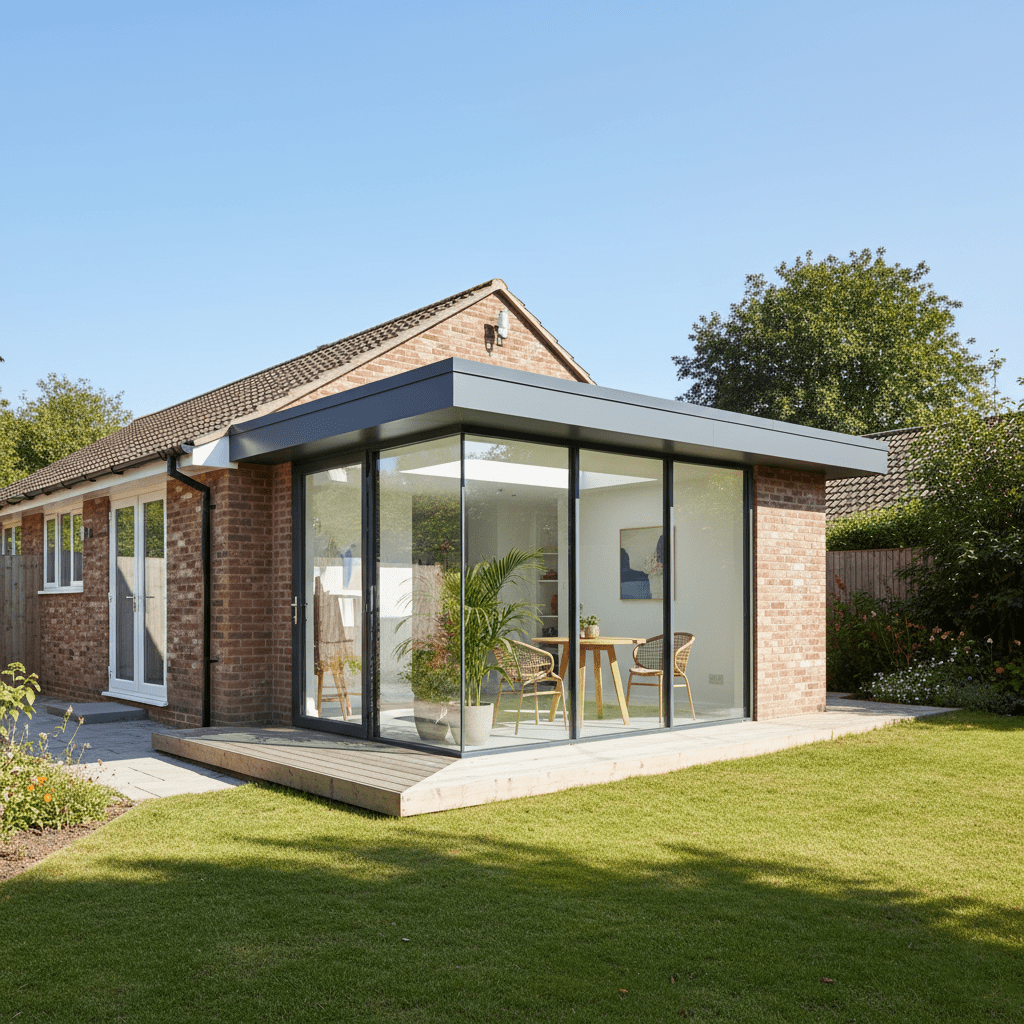
Lean-to or conservatory-style additions are among the most affordable house extension types. Small extensions built with relatively simple build methods. Their "almost conservative" idea adds valuable space without the cost and complexity of a full-scale rear extension.
An expert clearly explains how small conservatory-type extensions can be extended with bifold doors, maximizing both light and functionality while keeping costs under control.
5. Modular or Prefabricated Extensions
Modular extensions are becoming increasingly popular among homeowners trying to balance cost, speed and quality. As for home extension design, modular structures (such as garden rooms or container-like modules) can be more economical as most of the work is done off-site. Modular garden rooms are cheaper than traditional extensions, with costs estimated to be significantly lower than a full brick-and-mortar build. Because modules are made in a factory, waste is minimized, quality is consistent, and on-site disruption is minimal, all of which saves money.
6. Loft conversion
If you have roof space, going up rather than out can be a surprisingly cost-effective way of expanding. Real Homes estimates that a loft conversion can provide 22–28 square meters of space at a relatively low cost per square metre. House construction also breaks down the key cost drivers for a loft conversion are things like insulation, windows and structural work are important, so it's wise to factor in a 10-15% contingency.
Loft conversions can often be carried out under "permitted development" (avoiding full planning permission) depending on your local regulations, also reducing cost risk.
7. Garage or Shed Conversion
Converting your existing garage or shed into usable living space is one of the cheapest house extension approaches. The shell is already there, so you don't pay for a foundation or new external walls. A study states that converting a 15 square meter garage into a single room can cost between £6,000-£15,000 (depending on location and scope).
FloorPlan Expert also offers similar insights: with a garage conversion, you may need to remove garage doors, add windows and meet building regulations, but these costs are much lower than building a brand-new structure.
Converting a garage (even a double) can be significantly cheaper than building a new extension, often coming in at a fraction of the price per square metre.
8. Reuse, Recycle and Source Smart
Reusing materials is a smart way to keep costs down while adding uniqueness to your creation. Rescuing bricks, doors or flooring from an existing structure or local re-use centers. This not only saves money, but is also more sustainable.
When purchasing new ingredients, think local first. Also, sourcing from local suppliers to reduce transportation costs, which can significantly increase the budget.

9. Minimize structural changes
Every beam you remove, every wall you knock down, that's money. Avoiding unnecessary structural changes is an important way to reduce costs.
FloorPlan Expert also notes that removing load-bearing walls or changing the layout of the foundation may require steel beams or deeper footings, which are expensive.
Where possible, retain existing structural elements. Working with what you have, your current foundation, utility runs and walls is rather better than designing from scratch.
10. Invest in long-term efficiency
Spending a little more upfront on insulation, smart heating, or high-quality windows can reduce running costs over time. Choosing cost-effective but efficient heating systems (such as underfloor heating) and ensuring that insulation is well planned.
FloorPlan Expert also encourages long-term thinking: high-quality insulation not only lowers your energy bills, but can make your home more attractive to future buyers, improving your returns in the long run.
Putting all the above ideas together, here's a step-by-step approach to building your own extension without spending much:
Putting all the above ideas together, here's a step-by-step approach to building your own extension without spending much:
- Start with a clear plan – know what space you need, how you'll use it and how big it needs to be.
- Set a realistic budget – use expert advice to estimate costs, and include a buffer for surprises.
- Get detailed quotes – Ask multiple contractors for the breakdown (labor, materials, timeline) so you can compare. Do not go just by the minimum number, but also by the level of detail in each citation.
- Choose cost-smart materials – use standard sizes, and consider reused or modular components.
- Decide on the type of extension – a lean-to conservatory? Modular garden room? loft conversion? Choose the one that best suits your home and budget.
- Manage the project carefully – Whether you're DIYing parts of it or hiring a builder, strong planning and oversight will reduce waste and avoid costly changes mid-project.
- Think long term – invest in good insulation and energy-efficient features so you can save on usage and possibly increase the value of your home.

Conclusion
There's no one-size-fits-all solution to expanding your home on a budget but the strategies above provide a solid framework. By planning smartly, sticking to simple and efficient designs, reusing materials and choosing the right type of extension, you can add really useful space without depleting your savings. Whether it's a lean-to, modular garden room, loft conversion, or clever garage remodel, FloorPlan Expert is ready to help you with all your extension needs.